

Updated on 2/4/26 to reflect City Council meeting of 2/3/26
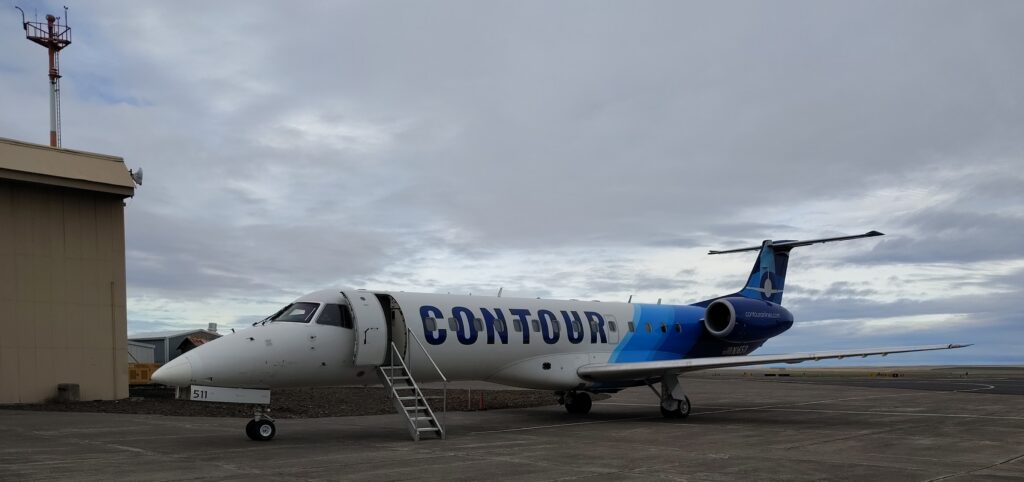
Many a tale has started with the promise of a free meal. This one began with a December invite to enjoy a free lunch spread at Pendleton Airport offered by one of the airlines vying for the Pendleton – Portland run currently serviced by Boutique Airline. The buffet was good, and the folks from Tennessee-based Contour Airlines were happy to show off the benefits that Pendleton might enjoy should they be granted the bid for the Pendleton-Portland route (currently the only daily scheduled flight between Pendleton and, well, anywhere).
On paper, Contour’s pitch is straightforward: Boutique Air flies Pilatus PC‑12 turboprops with eight or nine seats, offering 21 round‑trip flights per week under its current contract.

Contour, by contrast, operates 30‑seat regional jets. Even with fewer daily flights, the total number of available seats would increase significantly.
Shaping Pendleton’s future
But the issue is more complicated than passenger capacity, as I learned through a chance run in at Brett’s Books with City of Pendleton Economic Development & Airport Director Steve Chrisman, who informed me that two other airlines were vying for the route. One of these, California-based Advanced Air, is similar to Boutique, running slightly larger twin engine 350 turboprops with seating similar to Boutique’s PC-12s. The other, Utah-based SkyWest Airlines, brings 30-seat regional jets similar to Contour’s to the table.
My experience with air travel is limited to flying inside of planes (though once upon a time I jumped out of a perfectly good one in the name of journalism). Realizing I was in over my head, I asked Steve for clarification. He put me in touch with Airport Manager Dan Bandel.
An air traffic controller for 37‑years and former chief controller at the Eastern Oregon Regional Airport, Bandel now oversees airport operations and serves as a non‑voting facilitator for the Essential Air Service (EAS) selection committee. Through Bandel I learned that the distinction in plane size meant more than simply how many passengers can be served on any given day, but one shaping the perception of Pendleton and, perhaps, the future of our community.
“The bigger picture is airport credibility,” Bandel told me, and then proceeded to introduce me to a term known to few outside the aviation industry: “Part 139 Certification.”

The importance of Part 139 Certification
For the lay-person, Part 139 Certification is awarded to airports meeting strict safety and operational standards for serving commercial flights for planes with more than 9 seats for scheduled flights and 31 seats for charter flights. In order to get Part 139 Certification, an airport needs to adhere to regulations ranging from runway safety, firefighting, and wildlife management, as well as having comprehensive plans for emergencies, maintenance, and environmental hazards.
Pendleton previously held Part 139 status but relinquished it when service shifted to smaller aircraft. Being non-Part 139 certified isn’t unusual for regional airports, and it allows smaller airlines like Boutique Air to ferry passengers on smaller airplanes without having to go through the usual TSA formalities. While this may save time for travelers regularly using the 50 minute hop between Pendleton and Portland to get to appointments across the state, according to Bandel, remaining a non-Part 139 airline leaves little room for either growth or integration into the larger aviation network.
“Regaining Part 139 status opens the door to more opportunities,” Bandel said. “It strengthens our position in the aviation network and could eventually support direct flights to destinations beyond Portland.”
Weighing the pros and cons of Expansion
Bandel made it clear that, should Pendleton remain a non-part 139 certified airport, its commitment to safety would remain unchanged. But the benefit of switching to an airline offering larger aircraft has a number of benefits, both to Pendleton and to travelers. Regional jet operators like Contour or SkyWest typically offer interline agreements, allowing passengers to book travel from Pendleton to national and international destinations on a single itinerary. Expanded operations could also support additional aviation jobs, including maintenance roles and potential crew bases.
Bandel conceded that there might be an additional time commitment for passengers relying strictly on the PDT-PDX route, as the shift to Part 139 compliance will require outbound passengers to go through TSA screening in Pendleton, adding that this shouldn’t be too much of a burden given the size of Pendleton airport.
“If the committee selects a regional jet carrier, TSA screening will eventually return,” he said. “But I anticipate it will be a relatively painless process.”
As airport manager, Bandel doesn’t vote with the selection committee, a group composed of aviation professionals, tribal representatives, marketing professionals and the Economic Development Director. His position as Airport Manager puts him in the unique position of being a non-voting committee facilitator.
“My horse has no reins,” Bandel told me. “It just goes.”
Expansion may benefit Pendleton
Still, Bandel believes that a larger carrier will be of great benefit to the community, supporting commerce and attracting more people to Pendleton.
“Regaining our Part 139 status also creates jobs for maintenance personnel and possible crew members who might want to use Pendleton as their home base. Pricing for the Pendleton – Portland flight should still remain low, especially given the EAS, and expanding our operations will make booking tickets between Pendleton and other airports, nationally and internationally, a possibility. Expansion also opens up the possibility of direct flights between Pendleton and cities other than Portland.”
Bandel understands that not everyone in the community supports a potential change in airlines. Some are concerned that, should a larger airline take over the route from Boutique and be unable to fill their flights, regular flights between Pendleton and Portland might cease. According to Bandel, this is a highly unlikely scenario, as Pendleton currently benefits from a program known as the Essential Air Service (EAS) subsidy, which subsidizes air travel between low-population airports connecting smaller and medium sized regions to larger airports.
“The EAS has been in place for years, and I don’t see that support diminishing,” Bandel said. “If a larger carrier doesn’t thrive, the route can be reopened for proposals.”
Embracing change vs. status quo
While acknowledging that there are often divisions between those ready to expand and embrace change, and those who’d prefer to stick with the status quo, Bandel clearly sees expansion of Pendleton’s airport as a win-win scenario, increasing Pendleton’s profile and position as Gateway to Eastern Oregon.
“We might not be the largest airport in the region,” Bandel said, “but we’re definitely one of the most important.”
Pendleton’s airport already plays an outsized role in the region. It hosts arguably the busiest non‑military unmanned aircraft systems (UAS) test range in the country, supporting research, development, testing and evaluation for major aerospace partners.
As the selection process moves forward, the decision will shape not only how Pendleton connects to Portland, but how the city positions itself for future economic growth.
The Selection Committee will meet to vote on the issue of Airport Expansion on January 20th. We will update this story to reflect their decision.
Addendum: February 4, 2026
The January 20th meeting of the selection committee did not provide resolution. The issue was discussed further, and finally decided with a 6-1 vote on February 3rd, where the Pendleton City Council recommended switching Essential Air Services providers from Boutique Air to SkyWest Charter. This followed extensive public comments and a discussion among councilors regarding the benefits and drawbacks to each provider. Read more at: https://eastoregonian.com/2026/02/03/pendleton-city-council-recommends-skywest-charter-for-airport-service/